
Buoyancy modules supply the uplift needed for ROVs, AUVs, and other subsea systems to maintain stable, neutral buoyancy during operations in both shallow and deep-water conditions. These components help vehicles maneuver accurately, conserve energy, and remain steady in dynamic ocean environments while supporting applications such as marine research, offshore energy work, pipeline inspection, and subsea navigation. Through pressure-resistant materials and carefully engineered density properties, AUV and ROV buoyancy modules deliver reliable performance across a wide range of payload and mission requirements.
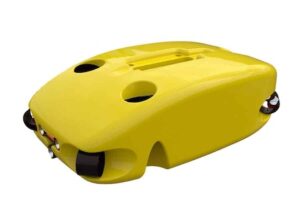

ROV & AUV Buoyancy Solutions by ALSEAMAR
Applications of AUV and ROV Buoyancy Modules
AUV Buoyancy systems support a wide range of subsea applications across engineering, science, and commercial operations. These applications are central to how ROVs, AUVs, and other underwater equipment perform tasks in varied ocean environments.
AUV Surveys
Underwater surveying relies on stable buoyancy to enable AUVs to follow precise trajectories and maintain consistent altitude during seabed mapping and hydrographic surveying, water-column profiling, and habitat assessment. Effective AUV buoyancy control improves data quality and reduces energy requirements for long-duration missions.
Pipeline Inspection
Pipeline inspection operations use inspection ROVs (observation class) that depend on consistent ROV buoyancy to navigate close to subsea infrastructure. Stability is vital when conducting visual assessments, identifying anomalies, or acquiring sensor readings along long stretch pipeline routes in both coastal and deep-water regions.
Construction
Subsea construction activities require reliable buoyancy support for intervention vehicles equipped with tools for installation, manipulation, and maintenance tasks. Balanced uplift ensures accurate positioning of equipment while minimizing operator workload during tasks around platforms, manifolds, and other subsea structures.
Salvage Operations
Salvage operations incorporate buoyancy systems to assist in the controlled lifting and repositioning of submerged objects. These structures help manage ascent rates, support rigging systems, and maintain the orientation of recovered items while reducing mechanical stress during recovery.
Environmental Monitoring
Environmental monitoring platforms depend on stable buoyancy to maintain their position while collecting chemical, biological, or physical measurements. These platforms operate across shallow and deep-water zones and require consistent buoyancy to support long-term datasets used in climate studies, ecosystem assessment, or regulatory compliance monitoring.
Subsea Exploration
Subsea exploration missions require buoyancy configurations that enable deep-water AUVs to operate reliably in areas where high pressure, darkness, and rugged terrain pose significant operational challenges. Balanced buoyancy enables these vehicles to traverse complex geologic features, collect samples, and record imagery while maintaining high energy efficiency.
Metrology
Underwater metrology tasks use buoyancy-controlled ROVs to achieve highly stable positioning while capturing dimensional measurements of subsea infrastructure. Accurate ROV buoyancy is essential for maintaining precise sensor orientation and for completing measurement routines without drift.
Defense Applications
Defense applications for buoyancy modules include navigation and inspection systems operating around critical maritime infrastructure. Consistent buoyancy helps ensure the performance of autonomous or remotely controlled systems conducting monitoring, security assessment, or object identification, both nearshore and offshore.
Port security ROVs also use buoyancy aids to maintain consistent buoyancy.
Types of Buoyancy Module
Design variations support different operational requirements across subsea vehicles and instrumentation. The main types include:
- Block modules, which mount directly to ROV and AUV frames and provide the primary uplift needed to balance structural mass and payload loads.
- Distributed modules, positioned along cables, risers, or tether systems, manage weight distribution and maintain stable orientation in the water column.
- Integrated buoyant structures, built into a vehicle hull to streamline hydrodynamics, centralize mass, and reduce drag during transit.
- Deep-water configurations, made from high-strength syntactic materials with embedded microspheres that remain dimensionally stable and pressure tolerant at significant depths.
- Shallow-water configurations, using lower-density materials suitable for nearshore and moderate-depth operations, where modularity and ease of installation are priorities.
Material Technologies
Syntactic materials are widely used for deep-rated buoyancy due to their combination of strength, low density, and consistent mechanical properties. Microspheres dispersed within the matrix define the system’s specific buoyant characteristics and compressive resilience. Structural inserts, composite housings, and modular blocks may be used to integrate buoyancy components with frames, sensor payloads, and vehicle structures. Shallow-water variants may make use of lighter composite or polymer-based materials that provide adequate uplift without the degree of compression resistance required at depth.
Standards and Qualifications
Buoyancy systems used in professional subsea operations are tested according to established standards to verify compressive strength, water-absorption limits, dimensional stability, and long-term pressure resistance. Additional requirements may apply in defense or mission-critical applications, including environmental testing for vibration, shock exposure, and operational reliability across a wide temperature range. Qualification processes ensure that buoyancy components maintain predictable behavior throughout extended subsea deployments.
The post Buoyancy Modules appeared first on Unmanned Systems Technology.
发布者:Summer James,转转请注明出处:https://robotalks.cn/buoyancy-modules/
