
The French Navy (Marine Nationale) is continuing to deploy ships to build Baltic Sea presence, to support national and NATO interests.
Aboard FS Sagittaire, at sea – Since early November, the navy’s Modernised Tripartite/Éridan-class minehunter FS Sagittaire has been deployed with NATO Allied Maritime Command’s (MARCOM’s) Standing NATO Mine Counter Measures Group 1 (SNMCMG1). The group participated in the Finnish Navy-led, multinational ‘Freezing Winds’ exercise, which took place in the Baltic in late November/early December. In recent months, the navy also deployed a Type A69 D’Estienne d’Orves-class patrolship into MARCOM’s Standing NATO Maritime Group 1 (SNMG1), also conducting Baltic operations.
SNMG1 and SNMCMG1 are MARCOM’s two North Atlantic-focused standing naval forces. Their area of operations is geographically vast, covering the Eastern Atlantic, through the North and Norwegian seas, and onwards respectively into the Baltic and Barents seas (and, in the latter case, the High North). However, both groups – especially SNMCMG1 – have spent much time in recent years in the Baltic, a region of current geostrategic significance for NATO due to its position as the Russo-Ukraine war’s northern maritime flank and a location where hybrid, ‘grey zone’ activity has increased. Consequently, the alliance has built up its Baltic enhanced vigilance activity (EVA) presence, such as through ‘Baltic Sentry’ – an EVA task established, in January 2025, to deter hybrid threats to critical underwater infrastructure (CUI).


Supporting NATO deterrence and defence requirements in the Baltic is a key driver for French Navy presence there.
“First of all, it’s to show the French Navy is involved in all NATO activities,” Commander Arnauld Boutroux, Sagittaire’s commanding officer (CO), told Naval News, in an interview onboard during ‘Freezing Winds’.
“In operations like ‘Baltic Sentry’ but also exercises like ‘Freezing Winds’, we can co-operate and increase our ability to work together, which is quite important because even if we’ve got the same NATO procedures, it’s not just a theoretical thing – we have to experience it with all the NATO navies.”
Commander Arnauld Boutroux
“The Baltic is a great place to do this, because we’ve got new NATO navies like Finland and old NATO navies like Germany, France, etcetera,” Cdr Boutroux added.

Integration impact
With exercises like ‘Freezing Winds’ focusing on ‘real-world’ problems present in the Baltic, deploying with SNMCMG1 is key to integrating national and NATO requirements and outputs.
“Integration is quite easy because we are part of a task group. Task group integration is quite natural now,” said Cdr Boutroux. With established NATO procedures to follow and with opportunities to integrate into the group’s planning process – sharing what both the navy and the Commander Task Group (CTG) want to achieve with Sagittaire – incorporating a ship into a task group and its activities is straightforward, Cdr Boutroux explained. “We are used to working together. We don’t change our way of working just because it’s an exercise. We exercise like we operate.”
Integrated task group activities also help optimise the ship’s operational outputs, Cdr Boutroux continued. “For a minehunter, you can’t describe the role without thinking about the whole task group …. A minehunter [working] alone will be less efficient than a task group dedicated to minehunting,” he said.
“‘Freezing Winds’ is a good example. With different capabilities, [the ships] are doing a complementary job; two minehunters in the same area will detect in slightly different ways, which increases efficiency and the probability of detecting every mine.”
Commander Arnauld Boutroux
“For France, it’s important that, as part of NATO, we operate in a task group for minehunting,” he added. “We have to show our allies … we work in a very efficient way together.”
Working with NATO partners in the Baltic’s challenging operational and environmental conditions is also enhancing ship and crew capability through lessons learned, the CO continued.
“I see this in two parts,” Cdr Boutroux said. “First, it’s really the weather …. We are working in very degraded [conditions].” Here, he explained, the winter-time colder water and rapid wind increases are different from other areas the navy habitually operates in. The colder water and reduced sub-surface visibility (due to shallower, murkier southern Baltic waters) also present more challenging operational conditions for the ship’s naval mine warfare (NMW) divers. “That kind of environment stuff is quite different, and is very useful for us to learn,” said Cdr Boutroux.
“Second, Baltic navies are quite used to minehunting: that’s something really in their culture, so we can share a lot of things …. The co-operation is very interesting for us,” the CO said. Here, he highlighted the ship’s work with a team of Royal Danish Navy divers. Sagittaire also conducted minehunting activities in partnership with the German Navy’s Frankenthal-class coastal minehunter FGS Dillingen.
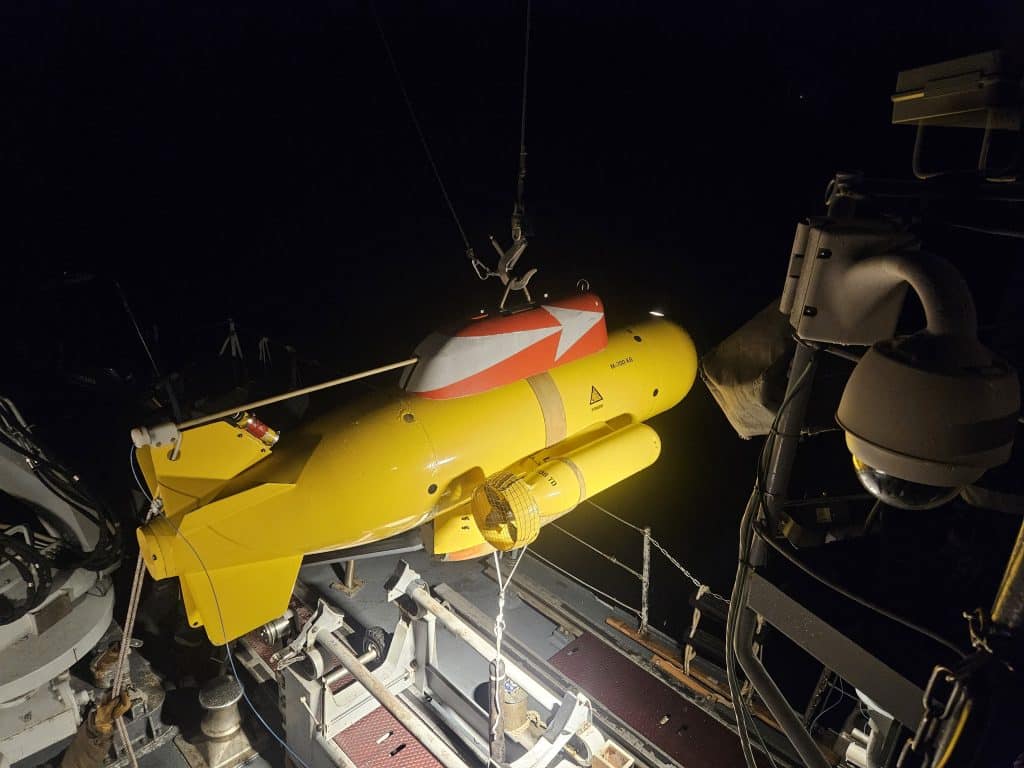
Combining these two parts, the crew learned to adapt its operational capabilities in response to the environmental conditions. To support NMW target identification, the navy’s Tripartite-class ships carry a pair of ECA PAP (Poisson Autopropulsé) 104 Mod 4 remotely operated vehicles (ROVs). “The water salinity is quite different, so we have to adjust the PAP in order to use it in the Baltic,” said Cdr Boutroux.
The post French Navy Baltic Presence Demonstrates NATO Commitment appeared first on Naval News.
发布者:Dr Lee Willett,转转请注明出处:https://robotalks.cn/french-navy-baltic-presence-demonstrates-nato-commitment-2/
