
Introduction to Drone Lithium Polymer Batteries
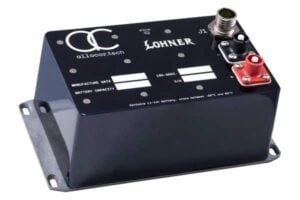

Lohner Smart Battery, a high-energy density LiPo solution, from Allocortech Inc.
Lithium Polymer (LiPo) batteries for drones and unmanned systems deliver a combination of high energy density, lightweight construction, and rapid discharge capabilities. Unlike the rigid cylindrical architecture of standard lithium-ion cells, LiPo drone batteries typically utilize a laminated foil pouch. This “soft pack” design is the industry standard for high-performance drones because it eliminates the dead space and weight of metallic casings, allowing for thin, high-surface-area cells that dissipate heat effectively during high-current operations. These individual pouch cells are commonly assembled in series and parallel configurations to form larger, mechanically reinforced battery packs suitable for medium and large unmanned platforms.
At its core, a lithium polymer battery for drone systems consists of a Lithium Cobalt Oxide (LiCoO2) or Nickel Manganese Cobalt (NMC) cathode and a graphite anode. The “polymer” refers to the gelled electrolyte matrix, which provides a safer, more stable medium for ion transfer than liquid electrolytes.
Professional integrators are increasingly adopting High-Voltage (LiHV) cells, which increase the peak charge voltage from 4.2 V up to 4.45 V. This shift translates to a significant gain in energy density, allowing for extended mission windows without increasing the airframe’s take-off weight.
Comparison with Other Battery Chemistries
Choosing the right drone LiPo battery requires a trade-off analysis against competing chemistries. While LiPo cells offer one of the best power-to-weight ratios for vertical lift, other chemistries serve specific roles:
| Chemistry | Energy Density (Wh/kg) | Discharge Rate | Cycle Life | Primary UAV Application |
| Standard LiPo | 150–220 | Very High (up to 100C) | 300–500 | FPV, Racing, High-Agility Tactical |
| High-Voltage LiHV | 230–290 | High (15C–40C) | 300–400 | Commercial Inspection, Cinematography |
| Li-ion (Silicon Anode) | 300–450 | Low to Moderate (3C–10C) | 500–1000 | Long-Endurance ISR, Mapping |
| LiFePO₄ | 90–140 | Moderate | 2000+ | Large-scale Utility/Safety-Critical |
| Solid State | 350–400 (estimated) | Moderate | 800+ | Next-Gen Industrial/Heavy-Lift |
Key Features of LiPo Drone Batteries
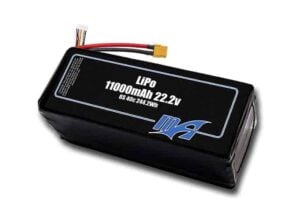
11,000 6S 22.2v Drone LiPo Battery Pack by MaxAmps Lithium Batteries
Lithium polymer battery technology is the standard choice for drone power because its performance characteristics meet the specific demands of flight. While other battery types have their own strengths, LiPo provides the necessary power and weight savings required for modern unmanned systems.
High Power Density and Responsive Thrust
A key advantage of drone lithium polymer batteries is their ability to provide high current delivery. This discharge rate (C-rating) ensures that the propulsion system can react to the rapid adjustments required by the flight controller. Consistent power delivery is vital for maintaining stability in turbulent conditions or during aggressive VTOL transitions, where high thrust must be maintained without the latency found in high-capacity lithium-ion cells.
Favorable Gravimetric Energy Density
Weight is a fundamental constraint in flight. LiPo cells provide an excellent energy-to-weight ratio for a high-discharge format. By eliminating the heavy metallic housing used in cylindrical cells, LiPo batteries allow more of the take-off weight to be used for sensors, gimbals, or cargo. This weight efficiency directly contributes to increased altitude ceilings and improved climb rates.
Consistent Discharge Curves for Flight Control
A UAV LiPo battery maintains a relatively flat voltage curve until the final 10% to 15% of its capacity. This consistency ensures that motor RPM and overall system power remain stable throughout the mission, allowing the pilot or autopilot to rely on predictable throttle responses from take-off to final approach.
Adaptable Form Factors
The pouch-style construction of LiPo cells allows for diverse design configurations. Manufacturers can specify thin, flat, or curved packs that fit within a fuselage or payload bay, lowering the center of gravity and reducing aerodynamic drag. This flexibility allows for better airframe integration than the rigid constraints of cylindrical cell banks.
Core Drone LiPo Battery Applications
Drone lithium polymer battery technology scales across diverse operational scenarios where power-to-weight ratios are the primary constraint.
Tactical and Reconnaissance UAVs
In defense ISR (Intelligence, Surveillance, and Reconnaissance) missions, LiPo is often the preferred chemistry for optimizing the endurance-to-payload balance. High discharge capabilities allow for the burst power required to lift heavy multispectral sensors or electronic warfare suites, while the lightweight pouch architecture ensures the airframe remains agile and portable for field-deployed units.
Industrial and Logistics Drones
Logistics platforms rely on extended flight duration through optimized energy density. By utilizing high-capacity LiHV packs, industrial drones can maintain 30+ minute mission windows while carrying significant payloads, such as medical supplies or inspection equipment. The high specific energy of LiPo minimizes the “dead weight” of the power source, maximizing the net weight of the goods delivered.
Swarm Drone Operations
Coordinating hundreds of units requires distributed power management. The small form factor and consistent discharge curves of LiPo cells enable precise, synchronized maneuvers across a swarm. Advanced flight controllers use the high-speed telemetry from LiPo packs to manage energy distribution across the fleet, ensuring that units with lower charge levels are rotated out of high-drag positions.
Field-Swappable Systems
Modern mission tempo demands continuous flight. Advances in battery modularity (including hardened “smart” casings and blind-mate connectors) allow for hot-swapping LiPo units in seconds. This modularity enables a “rolling fleet” model where depleted batteries are recharged in field-deployed hubs while fresh packs maintain persistent aerial presence.
LiPo Battery Charging Systems & Field Maintenance
Operational readiness is dictated by the efficiency of the charging infrastructure. For industrial fleets, the following standards are mandatory:
Smart Chargers and Balance Charging
Every lithium polymer drone battery must be balance-charged. Modern smart chargers monitor the voltage of individual cells via the balance lead, ensuring no single cell exceeds its peak threshold. In professional environments, chargers utilizing UAVCAN or Bluetooth interfaces allow fleet managers to log charging curves and detect early-stage cell degradation.
Portable Charging Stations and Solar Integration
For off-grid operations, portable DC-to-DC charging stations have largely replaced AC generators. These “power hubs” eliminate the harmonic distortion of petrol generators, which can damage sensitive charging circuits. High-efficiency solar arrays are increasingly paired with buffer batteries to provide a continuous 1C charging stream in remote field sites.
Cycle Life Management and Optimization
The industry standard for a UAV LiPo battery is 300 to 500 cycles before capacity drops below 80%. To reach this, a 1C charge rate is recommended for routine use. Charging at higher rates (2C+) accelerates electrode aging. Furthermore, maintaining a “Storage Charge” (3.80 V to 3.85 V) when batteries are idle for more than 24 hours is essential to prevent internal chemical breakdown.
Emergency Handling in Operational Environments
Damaged or swollen cells are a catastrophic fire risk. Field protocols require that “puffed” batteries are immediately removed from service. In the event of an impact or internal short, batteries should be quarantined in fireproof LiPo bags or sand-filled containers. Neutralization via a salt-water bath (0.0V terminal check) is the standard prerequisite for hazardous waste disposal.
Integration with UAV Power Management Systems
The interface between the LiPo battery and the airframe is a critical failure point. Effective power management requires a holistic approach to electrical standards and distribution architecture.
Electrical Interface Standards and Connectors
For 6S to 12S platforms, industry-standard high-current connectors are used to mitigate thermal runaway. These typically include anti-spark technology to minimize arcing during high-voltage connection. Advanced versions of these interfaces now integrate dedicated signal pins, allowing the Battery Management System (BMS) to share data directly with the flight controller. For defense-grade platforms, circular MIL-spec connectors (MIL-DTL-38999) provide environmental sealing and superior vibration resistance.
Power Distribution and ESC Compatibility
Proper integration requires ensuring the Electronic Speed Controller’s (ESC) Metal-Oxide-Semiconductor Field-Effect Transistors (MOSFETs) are rated for the peak charge of LiHV cells (4.45V per cell). High-power systems require low-ESR capacitor banks at the ESC input to smooth out the voltage ripples generated by active motor braking.
Redundant and Hybrid Power Architectures
To achieve high-value asset protection, redundant power buses are often employed. This involves dual-pack parallelism connected via a smart power selector. If one pack suffers a cell failure, the secondary pack assumes the load. In hybrid systems, a LiPo pack acts as a buffer to provide the transient current needed for VTOL phases, while a fuel cell or combustion engine provides cruise power.
Current Sensing and Telemetry Feedback
Professional drone LiPo battery packs provide a constant data stream to the Ground Control Station (GCS) via MAVLink or UAVCAN protocols. Hall Effect sensors provide precision accuracy, allowing the flight computer to calculate mAh consumed and State of Charge (SoC) in real-time.
Emerging Trends in LiPo Battery Technology
The industry is pivoting toward AI-driven diagnostics. Machine learning models now analyze discharge curves during flight to predict the “End of Life” for a battery pack weeks before physical symptoms appear.
Furthermore, the transition to semi-solid electrolytes is beginning to bridge the gap between traditional LiPo and true solid-state technology. These advancements promise to reduce the thermal runaway risks traditionally associated with lithium polymer batteries for drone use, while pushing operational ranges for specialized VTOL platforms toward the three-hour mark.
The post Lithium Polymer (LiPo) Batteries appeared first on Unmanned Systems Technology.
发布者:William Mackenzie,转转请注明出处:https://robotalks.cn/lithium-polymer-lipo-batteries/
